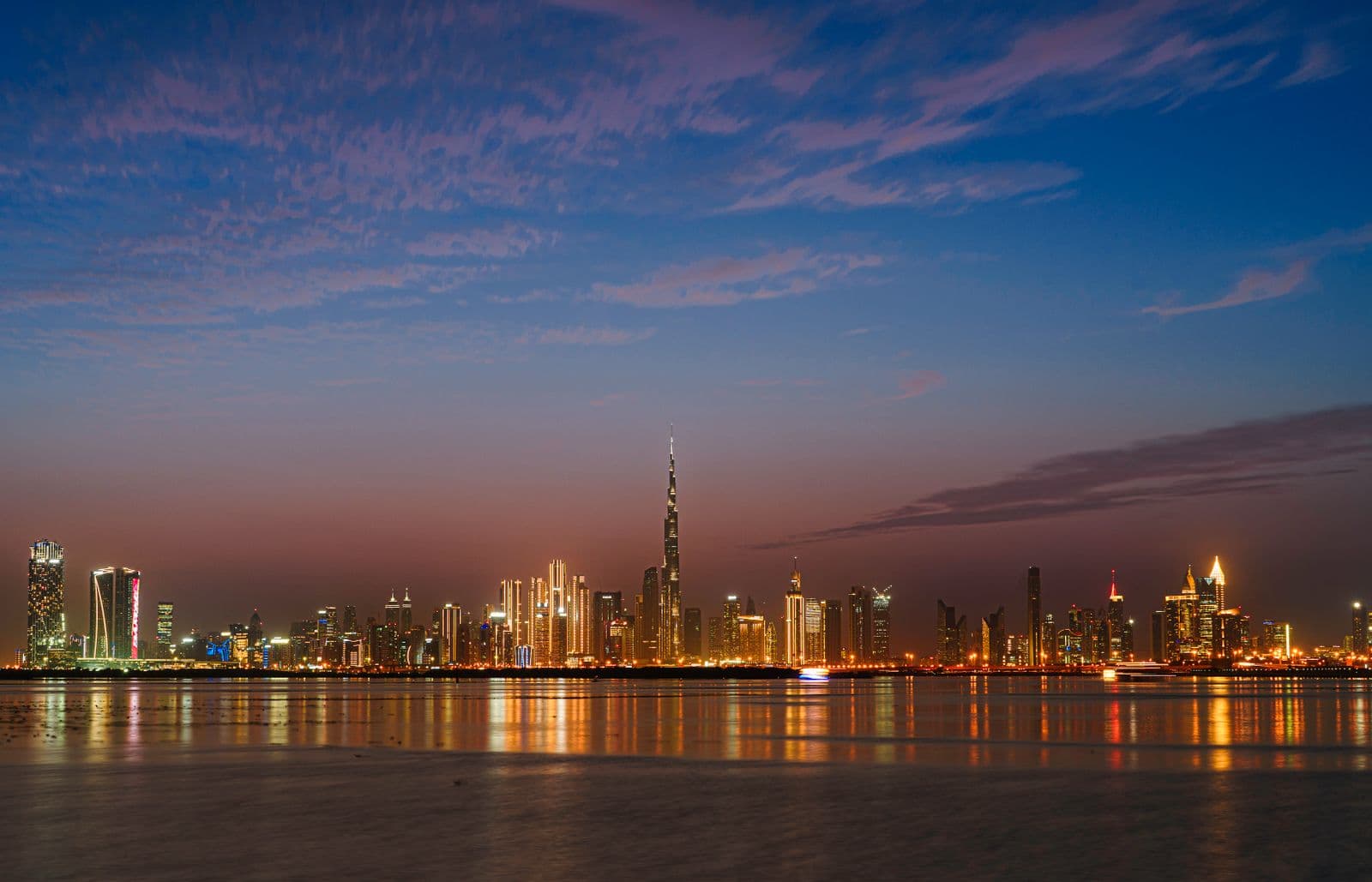
La Golden Visa de Dubái para quien compra un inmueble, la llamada visa dorada, es un permiso de residencia de 10 años y renovable. Puede solicitarla si es propietario de un inmueble en Dubái con un valor de compra de al menos 2 millones de AED, unos 545.000 USD al tipo fijo de 3,6725 dírhams por dólar que establece el Banco Central de los EAU. No necesita empleador ni patrocinador local, puede incluir a su cónyuge, sus hijos y sus padres, y las estancias largas en el extranjero no la anulan, siempre que no caduque mientras usted esté fuera de los EAU. La comprobación del inmueble corre a cargo del Departamento de Tierras de Dubái (DLD). Su página del servicio, actualizada por última vez el 14 de octubre de 2026 y consultada por nosotros el día 20, fija las tasas oficiales del solicitante principal en 9.884,75 AED y sitúa el plazo de tramitación entre 7 y 10 días hábiles.
Quién puede solicitar la Golden Visa de Dubái con un inmueble
El inmueble es solo una de las vías. La guía de la residencia dorada (Golden Residency) de la autoridad federal de inmigración, la ICP, contempla también a profesionales cualificados que ganan al menos 30.000 AED al mes, emprendedores, personas con talentos excepcionales y estudiantes destacados (consultado en octubre de 2026). La vía inmobiliaria es la que queda abierta a cualquier comprador, trabaje en lo que trabaje y gane lo que gane, y es la que trata esta página.
Puede solicitarla cualquier extranjero que sea propietario de un inmueble en Dubái que cumpla los requisitos. Las normas no dependen del pasaporte: un comprador español, mexicano, británico o ruso tiene que superar el mismo umbral de 2 millones de AED. La nacionalidad solo influye en un aspecto práctico. El DLD exige que el solicitante esté dentro de los EAU cuando se presenta la solicitud, y nadie puede presentarla en su nombre.
Lo que sí depende del pasaporte es cómo se entra en el país. Antes de viajar, compruebe en las páginas oficiales de la GDRFA, la ICP o el portal u.ae si su pasaporte da derecho a visado a la llegada y cuántos días de estancia permite: el propio portal u.ae advierte de que estas listas cambian de vez en cuando. Si necesita un visado previo, la ICP expide un permiso de entrada para inversores inmobiliarios con 300 AED en tasas, y su guía de la Golden Residency indica que los solicitantes que cumplen los requisitos y están fuera de los EAU reciben un visado de entradas múltiples de seis meses, renovable una vez, para completar el trámite (consultado en octubre de 2026).
El inmueble tiene que estar a su nombre. El DLD exige que sea «propiedad total del inversor», en uno o varios inmuebles, con un valor de compra total de 2 millones de AED o más.
Requisitos del inmueble para la Golden Visa de Dubái
La página del servicio del DLD mide el umbral por el valor de compra en el momento de la adquisición, tal como consta en el DLD, y no por el precio de mercado actual. Con ese criterio, un piso comprado por 2,1 millones de AED en 2023 sigue cumpliendo el requisito aunque el mercado haya bajado desde entonces, y uno comprado por 1,8 millones que hoy vale 2,3 millones no lo cumple. La GDRFA pide que el valor se acredite con un certificado de situación del inmueble emitido por el DLD y añade que un certificado de tasación de una oficina con licencia del DLD «puede aceptarse». Si su inmueble ha superado los 2 millones de AED desde que lo compró, pregunte al DLD si en su caso aceptarán una tasación. Y no plantee una compra justo por debajo del umbral confiando en que la acepten.
Se pueden sumar varios inmuebles
Dos apartamentos de 1,2 millones y 800.000 AED cuentan igual que una villa de 2 millones de AED. Las dos escrituras deben estar a nombre del solicitante. No hace falta vivir en ninguno. Puede alquilarlos, y a la Golden Visa le da igual dónde duerma usted realmente.
Inmuebles sobre plano
Las normas federales admiten una o varias unidades sobre plano con un valor total de al menos 2 millones de AED, siempre que se compren a un promotor autorizado por la autoridad local (guía de la Golden Residency de la ICP y Ministerio de Economía y Turismo de los EAU, consultados en octubre de 2026). En Dubái, la compra se inscribe en Oqood, el registro del DLD para ventas sobre plano. La página del DLD para inversores no menciona en absoluto las unidades sobre plano, así que tampoco dice qué parte del precio tiene que estar pagada, y los agentes inmobiliarios responden cosas distintas. Pregunte al DLD o al promotor cuál es la situación actual antes de firmar, no después.
Inmuebles hipotecados
Se admite la hipoteca si el préstamo procede de un banco local autorizado (ICP). La página del DLD, en su versión de octubre de 2026, pide una carta de no objeción en la que el banco declare que no se opone a un permiso de residencia vinculado al inmueble e indique el importe pagado y el saldo pendiente, y, si el inmueble está hipotecado, una carta del banco que confirme que se han pagado 2 millones de AED. Al pie de la letra, eso significa que lo que usted haya pagado tiene que llegar a 2 millones de AED, de modo que, con la redacción actual del DLD, una villa de 3,5 millones de AED con 1,4 millones pagados todavía no cumpliría el requisito. La página de la GDRFA se limita a decir que se aceptan inmuebles hipotecados.
Desde enero de 2024, The National y Khaleej Times, citando a un bufete y a agentes inmobiliarios, y en 2026 varias agencias de Dubái han publicado que un inmueble hipotecado cuenta por su valor total, independientemente de lo pagado. El DLD nunca lo ha anunciado: su página del servicio, actualizada el 14 de octubre de 2026, sigue pidiendo una carta del banco que acredite 2 millones de AED pagados, y en las páginas de la ICP tampoco encontramos nada. Mientras ese cambio no aparezca en sus páginas, tome como norma la carta del importe pagado y confírmelo con el DLD antes de plantear una compra con una entrada menor.
Copropiedad
La página del servicio de la GDRFA lo resuelve sin rodeos: si usted posee una parte de un inmueble, esa parte por sí sola tiene que valer al menos 2 millones de AED. Por tanto, si una pareja tiene a medias una villa de 4 millones de AED, los dos cumplen el requisito. Si lo que comparten es un piso de 2,5 millones, ninguno de los dos lo cumple, porque ninguna mitad llega al umbral y las partes no se suman. En ese caso lo más sencillo es que uno de los dos sea el titular del inmueble y patrocine al otro. Decídalo antes de que se redacte el contrato de compraventa: cambiar después los nombres de la escritura es una nueva inscripción, con sus tasas.
Cuánto cuesta la Golden Visa de Dubái
Hay dos facturas distintas: la compra del inmueble y la propia Golden Visa.
En la compra, el DLD cobra una tasa de registro del 4 % del precio. Su página de registro de compraventas la reparte en un 2 % para el comprador y un 2 % para el vendedor, pero quién paga qué se fija en el contrato de compraventa. A eso se suman 250 AED por el certificado de la escritura de propiedad y los honorarios de la oficina de registro autorizada (registration trustee), 4.000 AED más IVA en ventas de 500.000 AED o más (DLD, registro de compraventa, consultado en octubre de 2026). En un piso de 2 millones de AED, el 4 % son 80.000 AED. Con hipoteca, el DLD cobra además el 0,25 % del préstamo por inscribirla, y el banco aplica sus propias comisiones. La comisión de la agencia va aparte.
Para la Golden Visa, el DLD detalla estas tasas del permiso de 10 años del solicitante principal:
| Concepto | AED |
|---|---|
| Reconocimiento médico | 700 |
| Emirates ID | 1.153 |
| Confirmación de residencia | 2.856,75 |
| Tasas del DLD | 4.020 |
| Tasas administrativas | 1.155 |
| Total | 9.884,75 |
Fuente: DLD, solicitud de la Golden Visa para inversores, página actualizada el 14 de octubre de 2026. Cada familiar patrocinado se paga aparte: 5.774,50 AED por cónyuge, hijo o progenitor, más 100 AED por persona patrocinada y una tasa única de 318,75 AED por abrir el expediente familiar. Además, cada familiar a cargo necesita un seguro médico de los EAU. Una pareja con dos hijos suma unos 27.800 AED en tasas oficiales, sin contar el seguro. Si antes necesita un permiso de entrada para llegar al país, añada los 300 AED de la ICP.
Cómo se solicita
En Dubái, la Golden Visa por inmueble pasa primero por el DLD, que confirma la titularidad y el valor, y después por la GDRFA, que expide el permiso. Como puntos de atención, el DLD menciona Al Manara Center, el Golden Cube del Dubai World Trade Centre y varias oficinas de registro inmobiliario autorizadas.
- Revise el expediente: escritura o inscripción en Oqood a su nombre, valor de compra total de 2 millones de AED o más y, si el inmueble está hipotecado, las cartas del banco.
- Acuda en persona a un punto de atención, entregue la documentación y pague las tasas.
- Pase el reconocimiento médico; puede hacerlo en el mismo centro.
- Si se lo piden, deje sus huellas dactilares para la Emirates ID.
- Recibirá el permiso de residencia por correo electrónico y, más tarde, la tarjeta Emirates ID.
Para el solicitante principal, la documentación es breve: pasaporte, escritura o certificado electrónico de titularidad (e-title), una foto personal y, si ya los tiene, su Emirates ID y su permiso de residencia vigente. La lista de la ICP añade un pasaporte con al menos seis meses de validez y un seguro médico válido en los EAU. Para los familiares, el DLD pide copia certificada del contrato de matrimonio y de los certificados de nacimiento, seguro médico, un IBAN y, para los hijos mayores de 18 años, una declaración de que no están casados. Para los padres hace falta un certificado de dependencia económica con la certificación del consulado. Los documentos expedidos fuera de los EAU suelen tener que legalizarse para usarlos allí, y ese paso a menudo tarda más que la propia Golden Visa.
El DLD habla de 7 a 10 días hábiles desde la presentación. En la práctica el plazo se alarga cuando la carta de la hipoteca o los certificados legalizados llegan tarde, así que empiece por ellos.
Ventajas de la Golden Visa de Dubái, y sus límites
Lo que obtiene es residencia. Durante 10 años puede vivir en los EAU, abrir cuentas bancarias, sacarse el carnet de conducir, alquilar, matricular a sus hijos en el colegio y firmar los contratos del día a día que exigen la Emirates ID. La Golden Visa es autopatrocinada, así que no se extingue si cambia de trabajo o si nunca llega a trabajar en los EAU.
Los visados de residencia ordinarios de los EAU se anulan si su titular pasa más de seis meses seguidos fuera del país. Los titulares de la Golden Visa están exentos: según la GDRFA, su permiso solo queda anulado si vence mientras están en el extranjero. Muchos propietarios la tienen como segunda base y pasan la mayor parte del año en otro sitio.
Las normas para la familia son más amplias que las de un residente corriente. La guía de la ICP prevé permisos de residencia para el cónyuge, para los hijos sea cual sea su edad y para los padres, además del derecho a patrocinar a empleados del hogar. Si el titular principal fallece, los familiares patrocinados pueden quedarse en los EAU hasta que venzan sus propios permisos.
Lo que no obtiene es la nacionalidad. La Golden Visa es un permiso de residencia, y tenerla durante 10 o 20 años no da derecho a un pasaporte de los EAU. Tampoco cambia su situación fiscal en el país de origen. Dónde es usted residente fiscal depende de las normas de ese país y de un posible convenio para evitar la doble imposición, así que consulte a un asesor fiscal de allí.
Qué pasa a los 10 años o si vende el inmueble
La página del servicio de la GDRFA indica que sobre el inmueble se inscribe un gravamen para garantizar que la titularidad se mantenga durante toda la vigencia del permiso, y que este puede prorrogarse si se siguen cumpliendo las mismas condiciones (consultado en octubre de 2026). La renovación del décimo año es, por tanto, la misma comprobación: ¿sigue siendo propietario de un inmueble en Dubái que cumple el requisito? Si lo conserva, puede solicitar otros 10 años.
Vender es otra historia. Por el gravamen, no puede vender sin más durante la vigencia del permiso, y sin el inmueble la Golden Visa se queda sin base. Si quiere cambiar de activo, antes de anunciar nada pregunte al DLD cómo se levanta el gravamen y cómo se traslada la Golden Visa a un inmueble de sustitución. Con la compra sobre plano ocurre lo mismo: si la RERA, el regulador inmobiliario de Dubái, cancela un proyecto, la ley de cuentas de garantía (escrow) de Dubái obliga al promotor a devolver lo pagado mediante un procedimiento establecido que puede llevar tiempo. Pero una devolución no es un inmueble, y con ella desaparece la base de la Golden Visa. Si compra sobre plano, el historial de entregas del promotor importa tanto como el plano.
Si 2 millones de AED es demasiado: otros dos visados por inmueble
El DLD gestiona otros dos servicios de residencia para propietarios. Las dos páginas se actualizaron el 14 de octubre de 2026.
La Golden Visa para jubilados es para propietarios de 55 años o más cuyo inmueble valga al menos 1 millón de AED, por valor de compra o de mercado: el DLD acepta cualquiera de los dos. Un inmueble hipotecado cuenta cuando se ha pagado 1 millón de AED. Da un permiso de 5 años renovable, y el DLD indica 6.984,75 AED en tasas para el solicitante principal.
El visado de residencia para inversores (Taskeen) no exige un valor mínimo si el inmueble tiene un solo propietario. Los copropietarios necesitan una parte de al menos 400.000 AED cada uno. Dura 2 años y cuesta 10.212,50 AED para el solicitante principal, así que cubrir la década que da una Golden Visa supone presentar cinco solicitudes y pagar cinco veces las tasas. Algunas guías antiguas todavía hablan de un mínimo de 750.000 AED para propietario único, que el DLD suprimió en abril de 2026.
Por dónde empezar
Cierre primero el presupuesto: precio del inmueble, tasa del 4 % del DLD, honorarios de la oficina de registro y de la agencia, y unos 10.000 AED en tasas de la Golden Visa para usted más unos 5.900 AED por cada familiar. Después pida al DLD o a un agente inmobiliario registrado que le confirme cómo se valorará su operación concreta, sobre todo si hay hipoteca, una unidad sobre plano o una escritura compartida. Para hacer una primera selección, en el catálogo de HomeNSearch en los Emiratos Árabes Unidos hay 1.669 inmuebles en venta en Dubái; 800 cuestan 2 millones de AED o más, entre ellos 692 apartamentos y 61 villas (20 de octubre de 2026). Si deja margen sobre el umbral, por ejemplo desde 2,2 millones de AED, siguen quedando más de 700 entre los que elegir. Para cualquier norma que haya podido cambiar desde nuestra revisión, la referencia es la página del servicio del DLD.
Preguntas frecuentes
¿Cuánto dinero hace falta para la Golden Visa de Dubái?
Uno o varios inmuebles con un valor de compra total de al menos 2 millones de AED, unos 545.000 USD. A eso se suman la tasa de registro del 4 % del DLD en la compra y unos 9.900 AED en tasas de la Golden Visa para el solicitante principal (DLD, octubre de 2026).
¿Quién puede solicitar la Golden Visa de Dubái?
Por la vía inmobiliaria, cualquier extranjero que sea dueño en su totalidad de inmuebles en Dubái con un valor de compra conjunto de 2 millones de AED o más, que esté en los EAU al presentar la solicitud y que tenga un seguro médico válido allí. La nacionalidad no cambia las normas. Hay otras vías para profesionales cualificados, emprendedores, talentos excepcionales y estudiantes.
¿Se puede obtener la Golden Visa de Dubái con hipoteca?
Sí, si el préstamo es de un banco local autorizado. La página del DLD, en octubre de 2026, pide además una carta de no objeción del banco y otra que acredite que se han pagado 2 millones de AED del precio. Algunas agencias aseguran que la regla del importe pagado ya no se aplica, así que confírmelo con el DLD antes de comprar.
¿Sirve un inmueble sobre plano?
Las normas federales admiten unidades sobre plano de 2 millones de AED o más compradas a un promotor autorizado. La página del DLD no dice cuánto hay que haber pagado antes de solicitarla, así que confírmelo con el DLD antes de firmar.
¿Puede una pareja compartir un inmueble para la Golden Visa?
Solo si la parte de cada uno vale al menos 2 millones de AED (GDRFA). Si no, uno de los dos es el titular del inmueble y patrocina al otro.
¿Pueden los españoles obtener la Golden Visa de Dubái?
Sí, en las mismas condiciones que cualquier otro extranjero. La solicitud se presenta en persona en los EAU, así que antes de viajar compruebe en u.ae o en la web de la GDRFA si su pasaporte da derecho a visado a la llegada: estas listas cambian.
¿Qué pasa después de 10 años de Golden Visa en Dubái?
Puede solicitar la prórroga por otros 10 años si sigue cumpliendo las mismas condiciones, sobre todo la de ser propietario del inmueble que cumple el requisito, sobre el que pesa un gravamen durante todo el periodo (GDRFA). Si lo vendió sin sustituirlo, no hay base para renovarla. La Golden Visa nunca se convierte en nacionalidad.